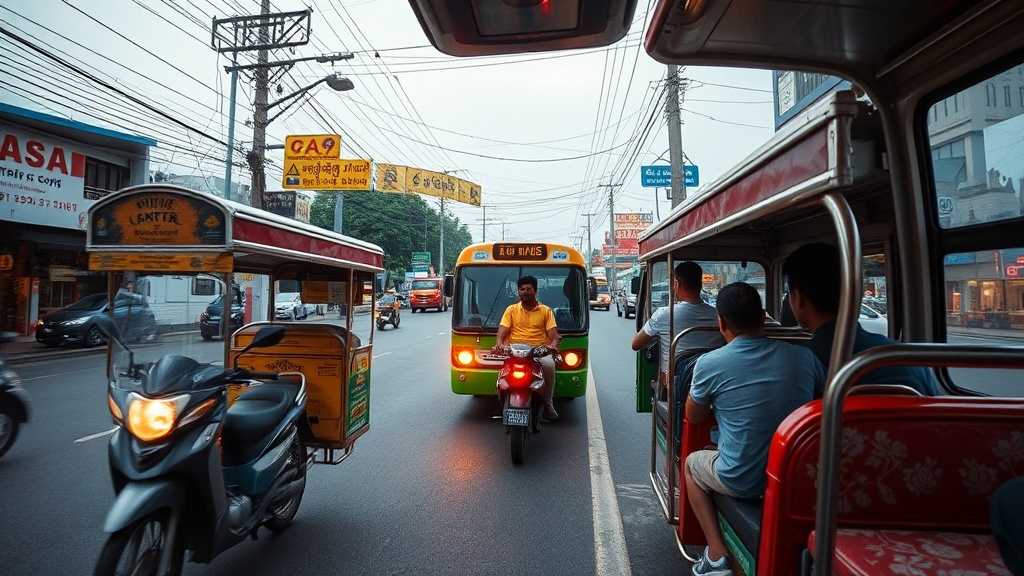
Finding Reliable Local Transport in Southeast Asia

Why Local Transit Is Not Just a Backup Plan
Many travelers assume that booking private drivers or high-end car services is the only way to move around safely and efficiently. This is a mistake. Relying solely on private transport often keeps you isolated from the real pulse of a city and drains your budget faster than expected. Real travel happens when you use the systems the locals use—be it a Tuk Tuk in Bangkok, a Jeepney in Manila, or a motorbike taxi in Ho Chi Minh City. This guide explains how to use these systems effectively without the stress of being overcharged or lost.
Understanding the rhythm of local transport allows you to see more of a culture in less time. It isn't just about getting from point A to point B; it’s about the sensory experience of the city itself. You'll find that the most interesting neighborhoods aren't always accessible by a luxury car service, but they are almost always accessible by a local bus or a shared van.
How do I avoid getting overcharged by drivers?
The fear of being ripped off is the primary reason people avoid local transport. However, there are ways to ensure you pay a fair price. First, always check if the vehicle uses a meter. In many Southeast Asian cities, the meter is the gold standard for pricing. If a driver refuses to use it, you've likely encountered someone trying to inflate the cost.
If there is no meter—which is common for Tuk Tuks or street-side taxis—negotiate the price before you step into the vehicle. A simple rule of thumb: ask for the price, state your destination, and if the price feels high, walk away. There is usually another driver just a few meters away. To make this even easier, download ride-hailing apps like Grab or Gojek. These apps provide a fixed price upfront, which removes the awkwardness of negotiation. Even if you don't use the app to book, you can use the price shown in the app as a benchmark for what a ride should actually cost.
- Grab: The dominant player across much of Southeast Asia.
- Gojek: Highly effective in Indonesia and parts-time parts of Vietnam.
- Bolt: Often offers slightly lower prices in Thailand and parts of Eastern Europe.
Using these apps isn't just about the price; it's about the digital footprint. If a driver behaves unprofessionally, you have a record of the transaction and the vehicle details. This provides a layer of security that traditional street hailing lacks.
Is it safe to use motorbike taxis for short distances?
Motorbike taxis (often called Ojek or Win) are incredibly efficient for cutting through heavy traffic, but they carry a different set of risks. While they are much cheaper than cars, they require a certain level of comfort with speed and balance. If you aren't used to the sensation of weaving through traffic, this might feel intimidating.
To stay safe, always look for a driver wearing a helmet. If they don't offer one, don't get on. It might feel awkward to insist, but your safety is more important than being polite. Also, keep your limbs tucked in. Avoid swinging your arms or legs around, as passing vehicles can be quite close. For long-distance travel, stick to cars or buses. Motorbikes are best reserved for short hops through dense urban centers where cars get stuck in gridlock.
Safety isn't about avoiding the local way of life; it's about participating in it with a prepared mindset.
For more information on global travel safety standards, you can consult the